

Affect and Disordered Attention in Chinese Video Art
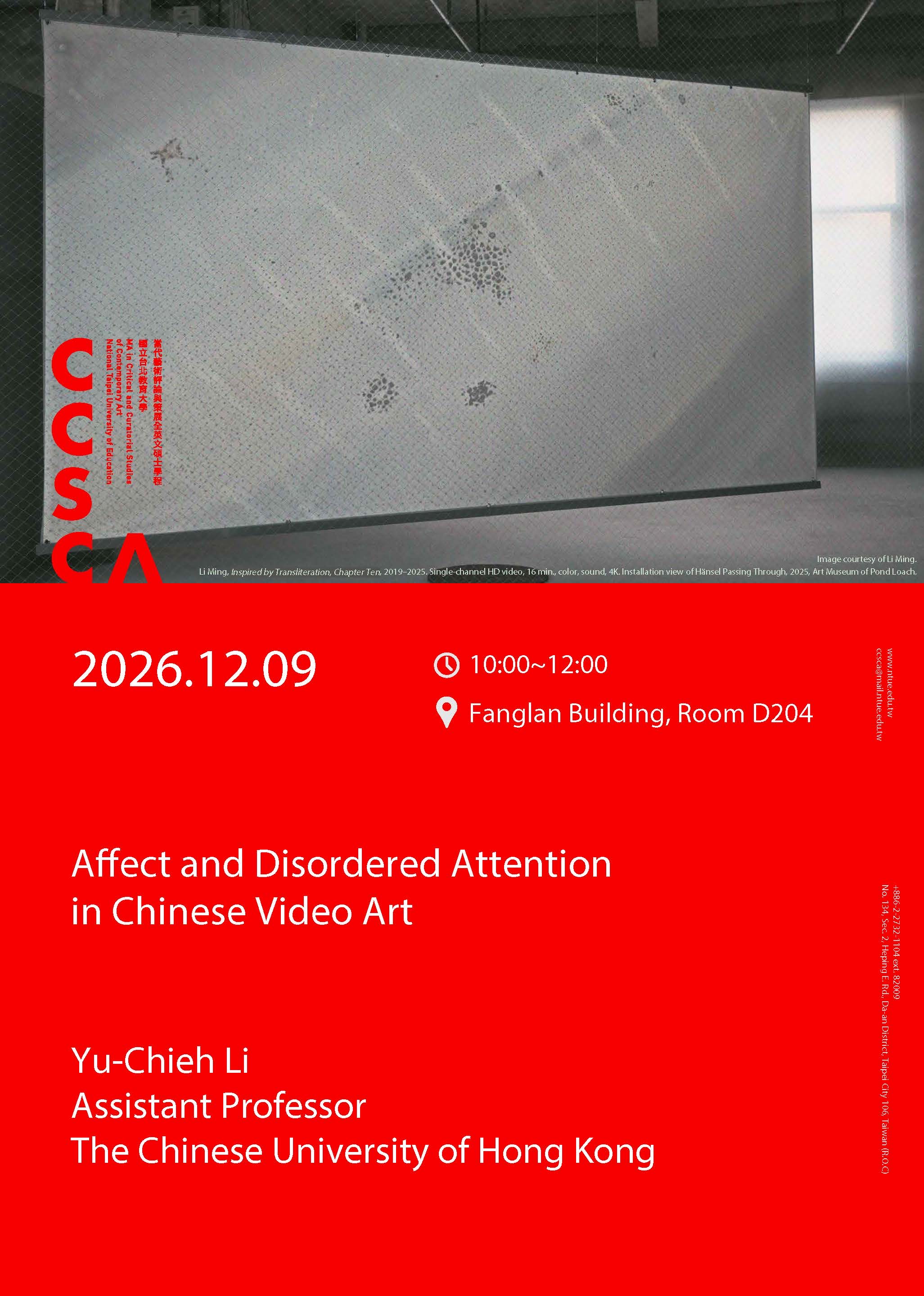
The transition from socialism to market capitalism in China has been accompanied by rapid developments in telecommunications, digital media, transportation infrastructure, and platform economies, profoundly reshaping perceptions of time, attention, and social experience. Scholars have observed that social media and mobile technologies generate new temporalities and patterns of attention, while transformations in broadcast media have accelerated viewing rhythms since the 1990s. At the same time, alternative practices such as "slow cinema" challenge these accelerated temporal regimes. My current project examines how Chinese video art from the 1990s to the 2020s has registered, critiqued, and reimagined shifting experiences of time and attention in post-socialist China.
Focusing on the work of second- and third-generation video artists including Jiang Zhi, Li Ming, Yu Guo, and Tao Hui, the project explores how increasingly accessible and mobile recording technologies enabled video to emerge as a medium uniquely suited to reflecting on affect, labour, and media consumption. Within the society of spectacle, these artists employ video to critique the commodification of attention and everyday life while exploring new forms of perception, temporality, and subjectivity. By tracing the aesthetic and political development of Chinese video art, this talk illuminates the politics of time in post-socialist moving-image practices and situates these works within broader debates on temporality in media studies and art history.
Guest Lecturer: Yu-Chieh Li (The Chinese University of Hong Kong)
Date: December 9, 2026 (Wednesday)
Time: 10:00-12:00
Venue: Fanglan Building, Room D204
國立臺北教育大學當代藝術評論與策展研究全英語碩士學位學程
National Taipei University of Education MA in Critical and Curatorial Studies of Contemporary Art
Tel: +886-2-27321104 ext.52165
Web | ccsca.ntue.edu.tw
Email | ccsca@mail.ntue.edu.tw
地址 | 10671 臺北市大安區和平東路2段134號
National Taipei University of Education